

Every business decision carries some level of uncertainty. A company may invest in a new product without knowing whether customers actually want it, enter the UAE with assumptions formed in another country, price a service without understanding local alternatives, or expand into a new emirate before confirming that demand can support the additional cost.
The problem is rarely a complete lack of information. It is making expensive decisions with incomplete, outdated, or poorly interpreted information.
This matters particularly in the UAE where companies operate across multiple emirates, mainland and free-zone structures, diverse customer segments, and highly competitive industries. Official UAE platforms themselves provide extensive information on economic activities, licensing, investment opportunities, prices, industries, and registered businesses, illustrating how many variables can influence a commercial decision.
Market research reduces this uncertainty before a company commits significant capital, hires a large team, signs long leases, develops inventory, or launches a major marketing campaign. It does not remove business risk completely. Instead, it helps management understand which risks are real, how serious they are, and which decisions should be changed before money is committed.
Why Business Assumptions Can Become Expensive in the UAE
Many failed business decisions begin with reasonable-sounding assumptions.
A successful retailer may assume that strong performance in its home country means customers in Dubai will respond similarly. A restaurant may see heavy footfall in a neighborhood and assume there is room for another concept. A manufacturer may identify rising industry demand and conclude that establishing a UAE operation is automatically commercially attractive.
Each assumption could be correct. The risk is acting before testing it.
For example, identifying a growing market does not answer several important questions: Which customer segment is driving the growth? How much are buyers willing to pay? Which competitors already dominate distribution? Are customers loyal to existing suppliers? How expensive will customer acquisition be? Is the opportunity concentrated in Dubai, Abu Dhabi, or elsewhere?
The UAE’s National Economic Registry, known as Growth, provides information on business licenses and more than 2,000 economic activities across the seven emirates. The Ministry of Economy and Tourism specifically notes that the platform can support businesses in studying market trends and developing strategies. Dubai’s official investment platform similarly separates business opportunities by industries and allows investors to examine business activities and compare company setup options.
That distinction is important. Market attractiveness and business viability are not the same thing. A sector can be expanding while an individual company’s proposed product, location, price, or operating model remains unattractive.
Good market research challenges those assumptions early, when changing direction is relatively inexpensive.
How Market Research Reduces the Most Important Business Risks
Market research works as an early-warning system. Instead of asking only, “Is this a good idea?” it breaks the decision into specific commercial questions that management can investigate individually.
WBS Advisory’s market research framework, for example, includes customer profiling, competitive analysis, data collection, market trends, forecasting, and strategy development. Its published UAE project examples also include competitive landscape analysis, segmentation, market requirements analysis, and feasibility assessment.
Those activities address different forms of business risk.
Reducing Demand, Customer and Competitive Risk
Demand risk occurs when businesses overestimate how many customers actually need or want what they intend to sell.
Consider a company planning to introduce a premium subscription service in Dubai. Management may know that the potential customer population is large. That tells them very little about the number of people who experience the specific problem being solved, consider it important enough to pay for, and prefer a subscription rather than a one-time purchase.
Market research narrows that uncertainty by examining target segments, purchasing behavior, customer priorities, available substitutes, and willingness to switch.
The same process reduces customer-fit risk. Two people with similar incomes may choose products for very different reasons. Business buyers may prioritize reliability and after-sales support, while consumers may place greater importance on convenience, brand reputation, location, price, or digital experience. Primary methods such as interviews, surveys, observations, and focus groups can explore these business-specific questions, while secondary sources help establish the broader market picture.
Competitive research adds another layer. A company needs to understand more than who its competitors are. It should examine how they compete.
Useful questions include:
- What products, packages, and price points are already available?
- Which customer groups appear underserved rather than merely large?
- How do competitors sell and distribute their products?
- What advantages would be difficult for a new entrant to copy?
- Where is the proposed offer genuinely different, rather than simply different in management’s opinion?
The result may confirm the original concept. Just as importantly, it may reveal that the business should target a narrower segment, enter through a different channel, modify the product, or avoid the investment altogether.
Avoiding a weak opportunity can be just as valuable as identifying a strong one.
Reducing Pricing, Market-Entry, and Operational Risk
Pricing decisions are particularly risky when they are built exclusively from costs.
A business may calculate its expenses, add a desired margin, and arrive at AED 500. But customers may see competing solutions at AED 350, or they may willingly pay AED 650 for a stronger service package. Without examining alternatives and purchasing criteria, the company does not know which situation applies.
Market research connects three variables: what customers value, what competitors charge, and what commercial model the business needs to remain viable.
The UAE Ministry of Economy and Tourism even operates an Essential Goods Prices Platform for comparing selected consumer-goods prices across major retailers, demonstrating the role that price visibility plays within parts of the UAE market.
Market-entry research also prevents businesses from treating the UAE as a single, uniform commercial environment. Companies must consider the nature of their economic activity and appropriate setup, including mainland and free-zone options. The UAE government’s business portal and Invest in Dubai provide separate guidance for these structures and activities.
Regulatory considerations can influence the commercial model as well. UAE consumer-protection rules establish obligations affecting suppliers and advertisers, while businesses also need to understand applicable tax requirements. Market research is not a substitute for legal or tax advice, but commercial research can identify these issues early enough for specialists to assess them before management finalizes its investment plan.
What UAE-Focused Market Research Should Actually Examine
A useful market study should not end with a description of industry size and growth. Management needs information that changes decisions.
For a UAE company, that normally means connecting market conditions with the proposed business model.
Research should establish the most promising customer segments, their purchasing criteria, current alternatives, competitors’ positioning, realistic price ranges, distribution channels, geographic differences, barriers to entry, and changes affecting future demand.
Local secondary research can begin with credible sources such as government economic data, licensing information, industry dashboards, business directories, competitor materials, and chamber resources. The Ministry of Economy and Tourism provides open datasets covering economic and investment indicators, while the National Economic Registry provides centralized information on enterprises and business activities. Dubai Chambers also offers market intelligence and industry insights specifically to support business decision-making and expansion.
Secondary information should then be combined with direct market evidence where necessary: customer interviews, distributor discussions, supplier conversations, competitor benchmarking, surveys, expert interviews, or field observations.
The objective is not to collect as much information as possible. It is to close the information gaps that could cause the business to make the wrong decision.
That is also why a market study designed specifically for one company is usually more useful than collecting generic industry reports. WBS Advisory describes its process as combining market requirements, customer profiling, competitive analysis, segmentation, forecasting, and decision-making, with published examples covering industrial suppliers and UAE market-entry and feasibility assignments.
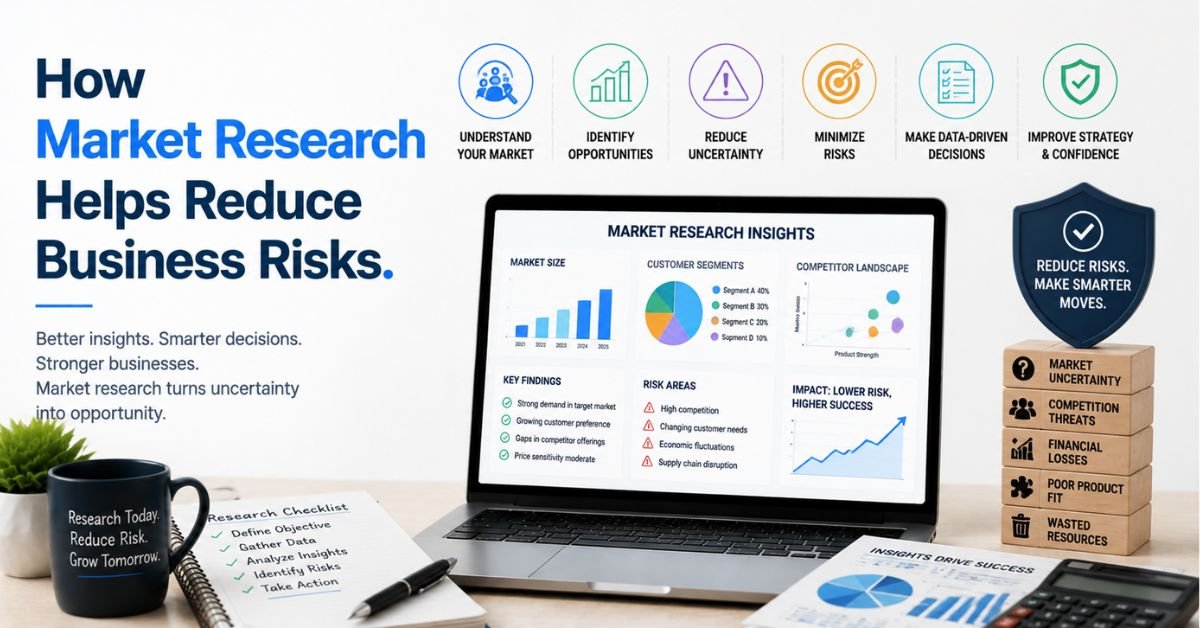
Turning Market Insights Into Lower-Risk Decisions
Research only reduces risk when management converts findings into action.
Suppose a company studies the UAE market and discovers strong customer interest but high resistance to its planned price. The wrong response is simply to note that “price sensitivity is a risk.” The business should decide what to do about it: reduce operating costs, introduce different packages, change its target customer, demonstrate greater value, or reconsider the launch.
The most practical approach is to use research as a series of decision gates before making increasingly expensive commitments.
A business can, for example:
- Validate Customer Demand Before Developing The Full Product;
- Test Pricing Before Committing To Large Inventory Volumes;
- Compare Locations Before Signing A Long-Term Lease;
- Assess Competitors Before Defining Positioning;
- Conduct A Pilot Before Expanding Across The Uae;
- Review Regulatory And Commercial Requirements Before Finalizing The Operating Model.
This approach turns market research from a report into a risk-management tool.
It is especially valuable before entering the UAE, launching a new product, opening another location, expanding into another emirate, changing prices, making a major capital investment, or evaluating an acquisition or new business opportunity.
The important question becomes not “Do we have enough data?” but “Do we have enough evidence to justify the next investment?”
That mindset protects capital because businesses can increase their commitments gradually as uncertainty decreases.
Conclusion
Successful businesses do not eliminate uncertainty before making decisions. That would be impossible. They reduce the most important uncertainties before those uncertainties become expensive mistakes.
Market research helps businesses determine whether genuine demand exists, identify the customers most worth targeting, understand competitive pressure, establish realistic pricing, select appropriate channels, assess market-entry conditions, and test assumptions before committing major resources. These are the same areas emphasized within WBS Advisory’s UAE market research services and project methodology.
In the UAE, this discipline is particularly valuable because businesses have access to significant opportunities alongside multiple customer segments, economic activities, jurisdictions, competitors and regulatory considerations. Official UAE platforms increasingly provide businesses with economic, licensing, pricing and market information that can support more informed commercial planning.
The biggest benefit of market research, therefore, is not simply knowing more about a market. It is knowing enough to make a better decision before the cost of changing that decision becomes high.
For businesses entering a new UAE market, developing a feasibility assessment, studying competitors, testing demand, or planning expansion, professional market research can provide the structured evidence needed to move forward with greater confidence rather than relying primarily on assumptions. WBS Advisory’s published market research approach covers these areas through competitive analysis, customer profiling, market requirements assessment, segmentation, forecasting, and strategic decision support.
Frequently Asked Questions
How does market research reduce business risk?
It identifies weaknesses in assumptions about demand, customers, competitors, pricing, and market conditions before a business commits substantial money or resources.
Is market research necessary before starting a business in the UAE?
It is highly valuable when the decision depends on uncertain demand, competition, location, pricing, customer segments, or market-entry conditions. UAE business structures and economic activities can also differ depending on where and how the company operates.
What should a UAE market research study include?
A practical study should examine target customers, demand, competitors, pricing, market requirements, segmentation, distribution channels, market trends and relevant barriers to entry.
What is the difference between primary and secondary market research?
Primary research collects new information directly through tools such as surveys, interviews, focus groups, and observation. Secondary research uses existing sources such as government information, industry data, business databases, and competitor materials.
When should an established company conduct market research?
Market research is useful before major decisions such as launching a product, changing pricing, entering a new customer segment, expanding geographically, opening another location or making a significant investment. Its value is greatest when the cost of making the wrong decision is considerably higher than the cost of validating the decision first.