

Mergers and acquisitions can give a business something organic growth often cannot: immediate access to customers, capabilities, talent, technology, intellectual property, distribution networks, or an entirely new market. Yet the same transaction can destroy value surprisingly quickly when the buyer pursues the wrong target, pays for benefits that never materialize, overlooks liabilities, or assumes the work ends when the agreement is signed.
That distinction matters particularly in the UAE. Deal activity remains substantial even as investors have become more selective. The MENA region recorded 390 M&A transactions worth US$46.7 billion in the first half of 2026 while PwC describes a regional market in which buyers are reassessing valuations and directing capital toward assets with clearer strategic value.
For UAE businesses, successful M&A therefore requires more than finding a willing buyer or seller. Strategy, valuation, financial and legal due diligence, tax implications, regulatory clearance, transaction terms, and post-deal integration all need to work together. WBS Advisory similarly positions strategy, deal structure, due diligence, valuation, regulatory approval, integration, communication, and risk management as interconnected parts of the M&A process.
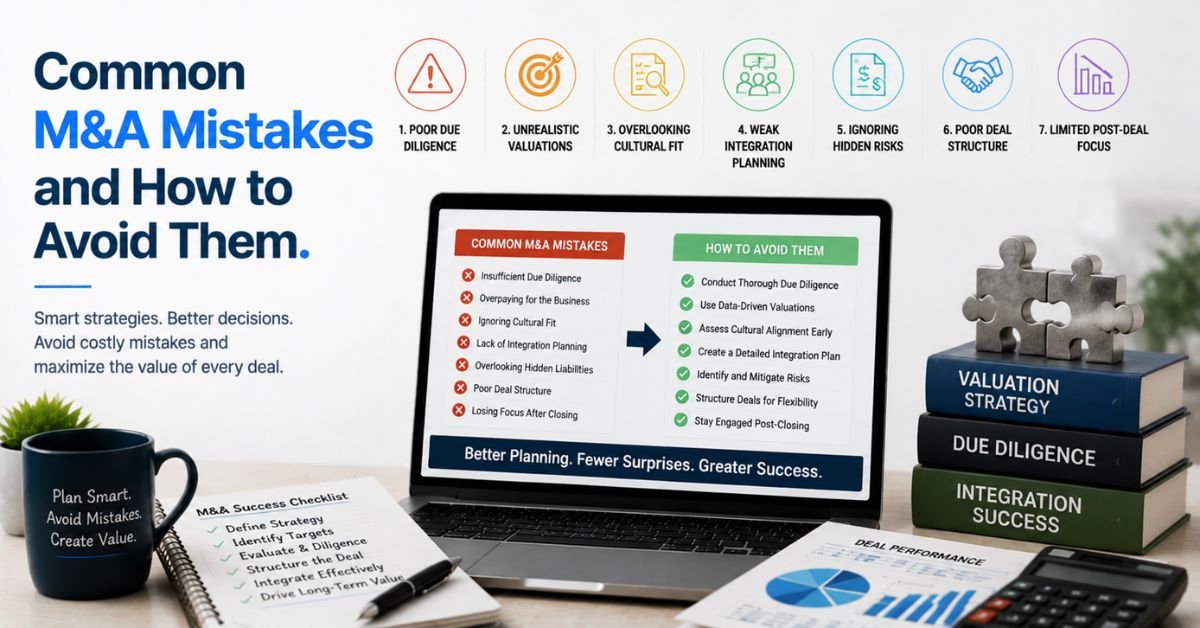
The following are some of the most common M&A mistakes businesses make and the practical steps that can prevent them.
Mistake: Falling in Love With the Deal Before Proving the Strategic Fit
One of the most dangerous moments in an acquisition occurs when management becomes emotionally committed to completing it.
Perhaps the target is a respected competitor. Perhaps entering a new UAE market appears attractive. Or perhaps management fears that another buyer will secure the opportunity first. Once that thinking takes hold, the question can quietly change from “Should we buy this company?” to “How can we make this acquisition happen?”
That change creates confirmation bias. Forecasts become increasingly optimistic, weaknesses are treated as temporary, and the purchase price starts determining the business case rather than the other way around.
A stronger M&A process starts with a clear deal thesis before serious negotiation begins. The buyer should know precisely what the acquisition is expected to deliver: market access, new customers, recurring revenue, technology, distribution, cost efficiencies, talent, or another measurable strategic advantage. PwC emphasizes that value creation should begin with clear strategic intent rather than treating the transaction itself as the objective.
Management should also define conditions under which it will walk away. These may include a maximum valuation, unacceptable customer concentration, excessive liabilities, loss of critical contracts, regulatory complications, or weak quality of earnings.
A transaction is not successful because it closes. It is successful only when the acquired business produces enough strategic and financial value to justify what was paid.
Mistake: Treating Due Diligence as a Box-Ticking Exercise
Due diligence is sometimes approached as verification: confirm the financial statements, inspect the contracts, ask the lawyers whether anything serious is wrong, and continue toward signing.
That is too narrow.
Effective M&A due diligence should test the assumptions on which the valuation depends. Financial diligence, for example, should examine normalized earnings, working-capital requirements, net debt, cash conversion and liabilities rather than simply accepting reported EBITDA. These findings may materially affect both valuation and the purchase-price mechanisms contained in the sale agreement.
The same principle applies outside the financial statements. UAE legal due diligence can uncover issues involving corporate governance, approvals, beneficial-ownership records, change-of-control provisions, employment obligations, disputes, licenses and commercial contracts. Such matters may delay completion, require renegotiation or alter the economic value of the transaction.
What robust UAE due diligence should cover
Rather than running separate workstreams that never connect, buyers should investigate how risks affect the investment case as a whole. Particular attention should usually be given to:
- Quality of earnings: Are profits recurring or are they inflated by one-off income, unusual accounting treatments, deferred expenditure or owner-related adjustments?
- Customers and suppliers: How dependent is the business on a handful of relationships, and can major contracts terminate following a change of control?
- Debt and working capital: Will the company require considerably more cash after acquisition than its headline profitability suggests?
- Legal and operational exposure: Are licenses, material agreements, intellectual property, employment arrangements and corporate records properly maintained?
- Tax position: Are corporate-tax and VAT filings sound, and does the proposed transaction structure create tax consequences that have not been reflected in the price?
Tax deserves particular attention in UAE transactions because restructuring relief is conditional rather than automatic. The Federal Tax Authority explains that qualifying business restructurings can receive tax-neutral treatment when the required conditions are satisfied, while relief may be clawed back in specified circumstances following the restructuring.
The important principle is simple: every material diligence finding should lead somewhere. It should either change the price, change the transaction structure, create a contractual protection, become a condition to closing, feed into the integration plan, or result in the buyer walking away.
Mistake: Focusing on the Headline Price Instead of What the Buyer Is Actually Paying For
Two companies can agree that a business is worth AED 100 million and still disagree significantly about the economics of the transaction.
Why? Because valuation is only one part of price.
Working capital, cash, debt-like items, outstanding liabilities, deferred consideration, completion accounts, locked-box arrangements, earn-outs and indemnities can all change the amount of value ultimately transferred between buyer and seller. Financial due diligence commonly examines normalized earnings, net debt and working-capital requirements precisely because these items feed directly into price negotiations and sale-and-purchase-agreement mechanisms.
Synergies create another trap. A buyer may reasonably expect to eliminate duplicate overhead, combine purchasing, cross-sell products or use the target’s distribution network. The mistake is paying the seller today for benefits that the buyer itself must create tomorrow.
For example, imagine a Dubai-based company values a target at AED 60 million independently but believes integration could generate another AED 15 million of value. Paying AED 75 million effectively hands the entire expected synergy upside to the seller while leaving the buyer responsible for executing it and carrying the risk that it never materializes.
Better deal discipline means separating standalone value from buyer-specific upside.
Before agreeing to the final economics, management should be able to answer three questions:
- What is the business worth based on sustainable standalone performance?
- Which synergies can realistically be delivered, by whom, and by when?
- How much of that future value should actually be reflected in the purchase price?
Where uncertainty remains high, transaction mechanisms such as earn-outs, deferred consideration, escrow or targeted indemnities can sometimes help allocate risk more appropriately. The exact mechanism should match the specific uncertainty rather than being added simply because it is common in M&A documentation.
Mistake: Considering UAE Regulatory Approval Only After Commercial Terms Are Agreed
Regulatory planning is not an administrative task to begin a few days before closing.
This has become particularly important under the UAE’s updated competition framework. Under Cabinet Decision No. 3 of 2025 an economic concentration may trigger notification where the parties’ total annual sales in the relevant UAE market exceed AED 300 million or their combined share exceeds 40% of transactions in the relevant market.
Federal Decree-Law No. 36 of 2023 requires qualifying economic concentrations to be notified at least 90 days before completion. The regime is suspensory: parties should not complete a notifiable transaction while approval is pending. The 2026 Executive Regulations added further detail around filing completeness, substantive review and the Ministry’s review procedures.
For dealmakers, the lesson is broader than competition law. Regulatory questions should be included in the transaction timetable from the beginning, particularly where businesses operate in regulated industries or where sector-specific approvals, licenses or ownership arrangements are involved.
A buyer that discovers a major approval requirement late may face a delayed closing, financing complications, renegotiation with the seller or an inability to execute the transaction according to the original timetable.
The safer approach is to map required approvals during the early stages of the deal and reflect them clearly in the transaction documents, conditions precedent and expected closing date.
Mistake: Waiting Until Closing to Think About Integration
Many M&A teams devote months to negotiating the transaction and only begin serious integration discussions once ownership changes hands.
By then, several avoidable problems may already be developing.
Employees may not know who they report to. Key people may start considering other jobs. Customers may receive inconsistent messages. Sales teams may compete rather than collaborate. Technology systems may not connect. Management may be unclear about decision-making authority. Meanwhile, the cost and revenue synergies used to justify the purchase price remain trapped in a spreadsheet.
Integration planning should therefore begin before closing wherever confidentiality and competition requirements permit. PwC identifies early operating-model planning, clear synergy ownership, communications, talent retention and change management as important components of successful integration. McKinsey likewise highlights management alignment, culture, integration speed and value-creation discipline as factors that can determine whether a transaction delivers its intended benefits.
Culture deserves special attention because it is operational, not cosmetic. Consider a founder-led UAE company acquired by a larger multinational. The target may rely on fast informal decisions and close customer relationships, while the buyer operates through formal approvals and centralized processes. Imposing the buyer’s systems immediately could unintentionally weaken the very capabilities that made the target valuable.
McKinsey emphasizes that cultural integration needs active management rather than being left to develop naturally after the transaction.
A practical integration plan should identify the people who must be retained, the systems and processes that must work on Day One, the synergies expected during the first year, the leaders accountable for each workstream, and the areas where the acquired business should deliberately remain independent.
Not everything needs to be integrated. The objective is not maximum integration; it is the level of integration required to deliver the deal thesis without damaging what made the target valuable.
Conclusion
Most M&A mistakes are not caused by one dramatic error. They accumulate.
A slightly optimistic forecast leads to a slightly higher valuation. Incomplete diligence leaves a liability undiscovered. Management assumes synergies will compensate for the premium. Regulatory work begins too late. Integration planning is postponed because everyone is focused on signing. Each decision may appear manageable on its own but together they can turn an attractive acquisition into an expensive problem.
The alternative is disciplined dealmaking: define the strategic rationale first, challenge valuation assumptions, conduct connected financial, legal, commercial and tax due diligence, structure the agreement around identified risks, address UAE regulatory requirements early and design the integration plan before closing.
That end-to-end approach is also consistent with the M&A advisory model described by WBS Advisory, which covers target assessment, valuation, due diligence, negotiation, regulatory considerations and the transition into the combined business.
As UAE and regional investors become increasingly selective about where capital is deployed, the strongest acquirers will not necessarily be those willing to bid the highest. They will be those that understand exactly why a business is worth acquiring, what could undermine that value, what they should pay for it and how they will create value after ownership changes.
Frequently Asked Questions
What is the most common mistake in an M&A transaction?
Starting a transaction without a clear strategic rationale is one of the most damaging mistakes. The buyer should define what value the acquisition must create and establish clear walk-away conditions before negotiations become advanced.
Why is due diligence important when acquiring a UAE company?
Due diligence can uncover financial, tax, contractual, employment, governance and operational risks that affect valuation, negotiation terms or whether the acquisition should proceed at all.
When can UAE merger-control approval be required?
Under the current federal thresholds, notification may be triggered when relevant UAE annual sales exceed AED 300 million or combined relevant-market share exceeds 40% subject to the Competition Law’s scope and applicable rules or exemptions.
How can a buyer avoid overpaying for an acquisition?
Separate standalone business value from expected synergies, normalize earnings and working capital, identify debt-like items, challenge management forecasts and establish a maximum price before competitive negotiations create pressure to increase the offer.
When should post-merger integration planning begin?
Integration planning should start before completion to the extent legally and practically permissible. Early decisions concerning leadership, talent, operating models, communications and synergy ownership can reduce disruption after closing.