

A business plan can look impressive and still fail at its most important job: helping people decide whether a business is viable, fundable and practical to execute.
This matters particularly in the UAE, where entrepreneurs must think beyond the business idea itself. Market positioning, pricing, operating costs, licensing, legal structure, tax treatment, staffing, location, and funding all influence whether the numbers in a plan make sense. The UAE Ministry of Economy and Tourism describes a business plan as a practical blueprint covering how a company will be structured, operated, developed, and financed, and notes its relevance to financiers, licensors, and banking authorities.
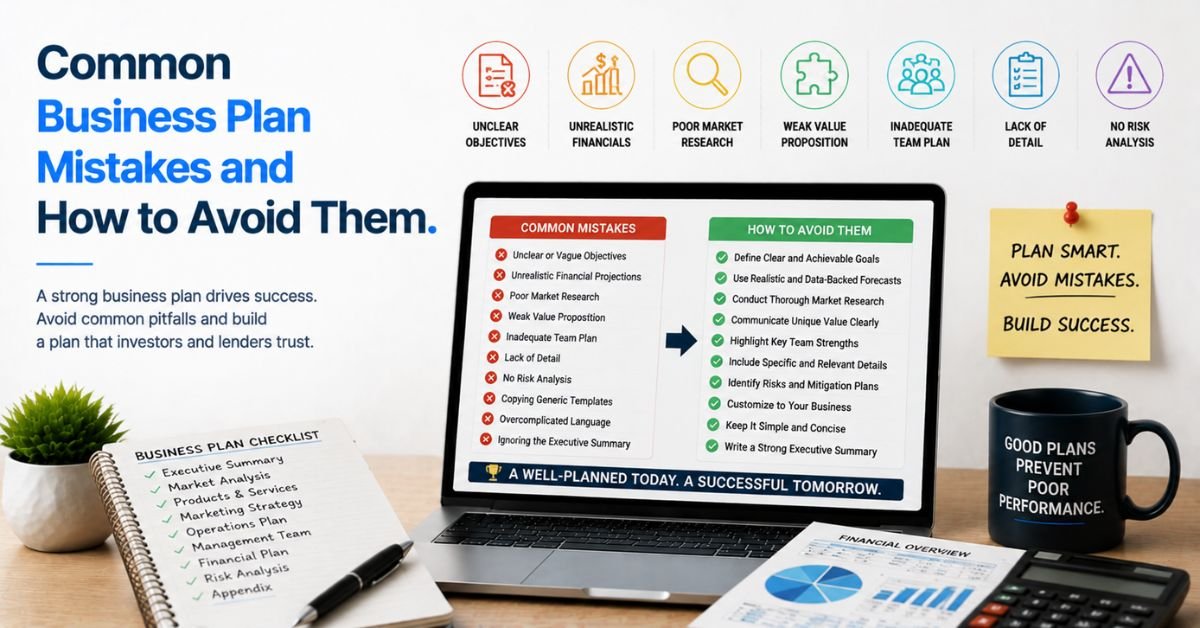
The biggest business plan mistakes rarely come from poor formatting. They come from unsupported assumptions, vague market definitions, unrealistic financial forecasts and plans that do not reflect how the company will actually operate.
Here are the mistakes UAE entrepreneurs should pay closest attention to and how to avoid them.
Why Business Plans Fail Before the Business Even Starts
One of the first mistakes is treating the business plan as a document that must simply be completed.
A good plan is a decision-making tool.
Before writing it, determine who will use it and what decision you want them to make. A founder creating an internal roadmap needs different emphasis from an entrepreneur approaching an investor, lender, strategic partner, or licensing-related authority. WBS Advisory similarly structures business plans around areas such as the executive summary, market analysis, business model, operations, financial projections, and risk assessment, while tailoring plans to different objectives such as investment, expansion, and business setup.
Without a clear purpose, entrepreneurs often make two opposite mistakes: they either produce an unnecessarily long document filled with background information or create a brief promotional document that does not answer serious commercial questions.
Before drafting, define four things:
- Who will read the business plan?
- What decision should the reader make after reading it?
- Which assumptions will matter most to that decision?
- What evidence will support those assumptions?
This simple step keeps the document focused. An investor for example, may want to understand scalability, returns, management capability, funding requirements and exit possibilities. Management may care more about budgets, hiring, sales targets, capacity and implementation milestones.
The format should follow the purpose not the other way around.
The Most Damaging Business Plan Mistakes
Defining a Large Market Instead of a Real Customer Base
A common mistake is confusing a large industry with a large opportunity for one specific company.
Imagine an entrepreneur planning to open a premium fitness center in Dubai. Saying that Dubai has a large fitness and wellness market does not establish demand for that particular gym. The important questions are narrower: Who is likely to join? Where do they live or work? What are they currently paying? Which competitors serve them? Why would they switch?
The UAE Ministry of Economy and Tourism recommends that market analysis address target-market characteristics, market size, relevant trends, demand, and competitor positioning rather than relying on a broad description of an industry.
Another frequent error is writing that a business has “no competitors.” Almost every company competes for the customer’s money, time, or attention, even when there is no business offering exactly the same product.
A cloud kitchen may compete with restaurants, delivery-only brands, supermarkets, meal subscriptions, and home cooking. A new accounting platform may compete with software providers, spreadsheets, outsourcing firms, and companies choosing to continue with their existing processes.
How to avoid it: Move from broad market size to achievable demand. Define customer segments, locations, purchasing behavior, price sensitivity, alternatives, and realistic routes to acquisition.
Your market section should be able to answer:
Why will a specific group of customers buy from this company rather than continue using the alternatives available to them?
That question is much more valuable than simply demonstrating that an industry is growing.
Building Financial Projections Around Optimism Rather Than Business Drivers
Unrealistic financial forecasts are among the quickest ways to weaken an otherwise promising business plan.
The problem is usually not an ambitious revenue target. The problem is failing to demonstrate how the company will reach it.
For example, projecting AED 5 million in annual sales provides little insight on its own. A stronger forecast explains the operational equation behind the number: customers acquired × purchase frequency × average transaction value.
The same logic should extend to expenses.
Startup plans frequently underestimate working capital because they focus on obvious costs such as equipment and premises while overlooking license expenses, deposits, professional fees, marketing, recruitment, inventory, software, insurance, utilities, and the period between paying suppliers and receiving customer payments. The UAE Ministry of Economy and Tourism specifically advises founders to include setup costs, rent, licensing, product development, marketing, manpower, equipment, facilities, and overhead when calculating startup capital.
Cash flow also deserves separate attention. A profitable business can still experience financial pressure when customers pay in 60 days but suppliers and employees must be paid much earlier.
How to avoid it: Build forecasts from measurable assumptions rather than starting with the revenue figure you would like to achieve.
For every major number, ask: What has to happen operationally for this number to become true?
Create at least a realistic base case and a downside scenario. Test what happens if the launch is delayed, customer acquisition costs more than expected, sales develop more slowly, rent increases, or margins are lower.
Tax assumptions also need to match the business model. For example, UAE VAT registration becomes mandatory for resident businesses when taxable supplies and imports exceed AED 375,000 over the relevant period, subject to the detailed FTA rules. A forecast that reaches this level but ignores the resulting tax and administrative implications may therefore need revision.
Good financial projections do not try to predict the future perfectly. They demonstrate that management understands what drives the economics of the business.
Ignoring UAE Licensing, Location and Tax Reality
A business model cannot be separated from the regulatory structure through which it will operate.
One mistake is designing the entire commercial plan first and deciding on the licence, jurisdiction, legal form, and operating structure afterward.
UAE government guidance states that the selected business activity forms the basis for determining the appropriate legal form and type of licence for mainland businesses. Dubai’s official Invest in Dubai platform likewise provides activity-specific searches and distinguishes between mainland and free-zone setup options.
That matters because the operating model should be compatible with the planned activity from the start.
Suppose an entrepreneur prepares an e-commerce plan assuming a certain warehousing model, payment flow, importing arrangement, and customer geography. The eventual licence and location should support that model. Changing the structure after the financial plan has been completed could affect costs, premises, staffing, tax treatment, logistics, or the way customers are served.
Free-zone tax assumptions require particular care. It is a mistake to put “0% corporate tax” into a business plan simply because the company will be established in a free zone. The Federal Tax Authority explains that preferential treatment for a Qualifying Free Zone Person depends on specified conditions and on the nature of qualifying income; income that does not meet the relevant conditions can be subject to the standard Corporate Tax treatment.
How to avoid it: Validate the operating structure while developing the business model, not after finishing it.
Your plan should clearly identify the intended jurisdiction, licensed activities, premises requirements, tax assumptions, required approvals where relevant, hiring needs, supplier arrangements, and realistic setup timeline.
The goal is not to turn a business plan into a legal manual. It is to prevent commercial projections from being built around an operating structure that does not work in practice.
Producing a Polished Document Without an Executable Strategy
Some business plans are beautifully designed but leave an important question unanswered: What exactly happens after approval or funding?
This usually occurs when entrepreneurs rely too heavily on templates.
Generic statements such as “we will use social media to build awareness,” “we will provide exceptional service,” or “we will expand across the GCC” sound positive but do not constitute strategy.
An executable marketing plan should explain who will be targeted, which channels will reach them, what the expected customer acquisition process looks like, how much has been budgeted, and what will be measured. UAE Ministry guidance similarly identifies distribution, pricing, promotion, marketing budgets, sales methods, and implementation timelines as important parts of business planning.
The operational plan should be equally concrete. The Ministry recommends describing organizational structure, leadership responsibilities, day-to-day operations, implementation, and the expected timeline to begin generating revenue.
Another mistake is hiding risks because founders fear that acknowledging them makes the business appear weak. In reality, a credible risk section is stronger when it explains both the risk and the response.
Instead of writing “competition is a risk,” explain what happens if a major competitor reduces prices. Instead of stating “supplier risk,” identify whether alternative suppliers are available and how much switching would affect margins.
Finally, do not treat the finished document as permanent. Business plans should be compared with actual performance and updated as assumptions change. UAE Ministry guidance specifically recommends comparing operating results against goals and timelines, while the U.S. Small Business Administration likewise advises businesses to measure results and update their plans.
A practical final review should test whether:
- Revenue assumptions connect to customer acquisition, pricing, and capacity.
- Expenses reflect the real UAE operating model.
- Responsibilities and implementation dates are clearly assigned.
- Major risks have specific mitigation actions.
The best business plan is therefore not necessarily the longest. It is the one in which the commercial story, market evidence, operating model, and financial numbers all support one another.
FAQs
What is the most common mistake when writing a business plan?
Using assumptions without explaining or validating them. Market demand, pricing, sales forecasts, costs, and growth targets should all have a clear basis.
How long should a business plan be?
There is no ideal page count. The UAE Ministry of Economy and Tourism notes that there is no single formula for an effective business plan; what matters is covering the important commercial, market, operational, and financial elements clearly.
Do I need a business plan to start a company in Dubai?
Requirements vary according to the purpose, activity, jurisdiction, authority, and funding situation. Business plans are particularly valuable for investment, financing, feasibility assessment, strategic planning, and certain setup or approval situations.
How can I make financial projections more realistic?
Build sales from operational drivers such as customer numbers, pricing, order frequency, conversion rates, and capacity. Then include startup expenses, ongoing operating costs, working capital, taxes where applicable, and downside scenarios.
Should an existing UAE company update its business plan?
Yes. Comparing actual performance with planned targets helps management identify where assumptions have changed and where strategy, budgets, or timelines need adjustment.