

Entering a new market, launching a product, changing prices or expanding into another customer segment often looks straightforward on a spreadsheet. The real difficulty is that business decisions are made before the market reveals whether those assumptions were correct.
That is where market research earns its value. It helps businesses understand customers, identify opportunities, assess competitors, reduce avoidable risks, and make better decisions about products, positioning, pricing and growth. WBS Advisory similarly frames market research as a combination of customer insight, competitive analysis, market requirements, segmentation, forecasting, and strategic decision-making.
For companies operating in the UAE, the need for good market intelligence is particularly important. Businesses may serve Emiratis, expatriate residents, tourists, corporate buyers, government entities, or highly specialized industry segments within the same market. Dubai’s official statistics, for example, separately track Emirati and non-Emirati populations, while the city’s official portal describes Dubai as a multicultural environment. That diversity makes broad assumptions about “the UAE customer” especially risky.
The good news is that market research does not have to mean commissioning one enormous study. The most useful approach is often to combine several methods, each answering a different business question.
Secondary Research Should Usually Be Your Starting Point
Before asking customers anything, find out what is already known.
Secondary, or desk, research uses information that has already been collected. It can include government statistics, economic indicators, industry publications, trade information, competitor websites, company filings, pricing pages, marketplace data, and existing internal reports. Primary research, by contrast, collects new information specifically for the decision at hand.
For UAE businesses, secondary research can be particularly productive because several official data resources are publicly accessible. UAE.Stat provides national datasets across demographic, economic, social, education, health and other categories. Dubai also provides public-sector datasets through its open-data infrastructure, while Statistics Centre Abu Dhabi publishes economic and demographic information and allows users to request statistical data on areas including economy, industry, and business.
Imagine an overseas manufacturer considering a distribution operation in Dubai. Before interviewing distributors, it could examine the size and structure of relevant industries, identify licensed competitors, review import and trade information, compare competitor product ranges, study customer segments, and map potential sales channels. The purpose is not to make the final decision from desk research alone. It is to identify what is already clear and, more importantly, what still needs to be tested.
WBS Advisory’s published project examples show this approach in practice. Its market research portfolio includes secondary market analysis of the UAE involving competitive landscape analysis, segmentation, market requirements, and feasibility assessment.
A common mistake is treating secondary research as a collection exercise. A folder containing dozens of reports is not an insight. Good desk research should finish with a decision-oriented summary: What do we know? What do we suspect? What must we verify directly with the market?
Primary Research Reveals What Customers Think and Why
Once the information gaps are clear, primary research allows a business to speak directly with the people whose decisions matter.
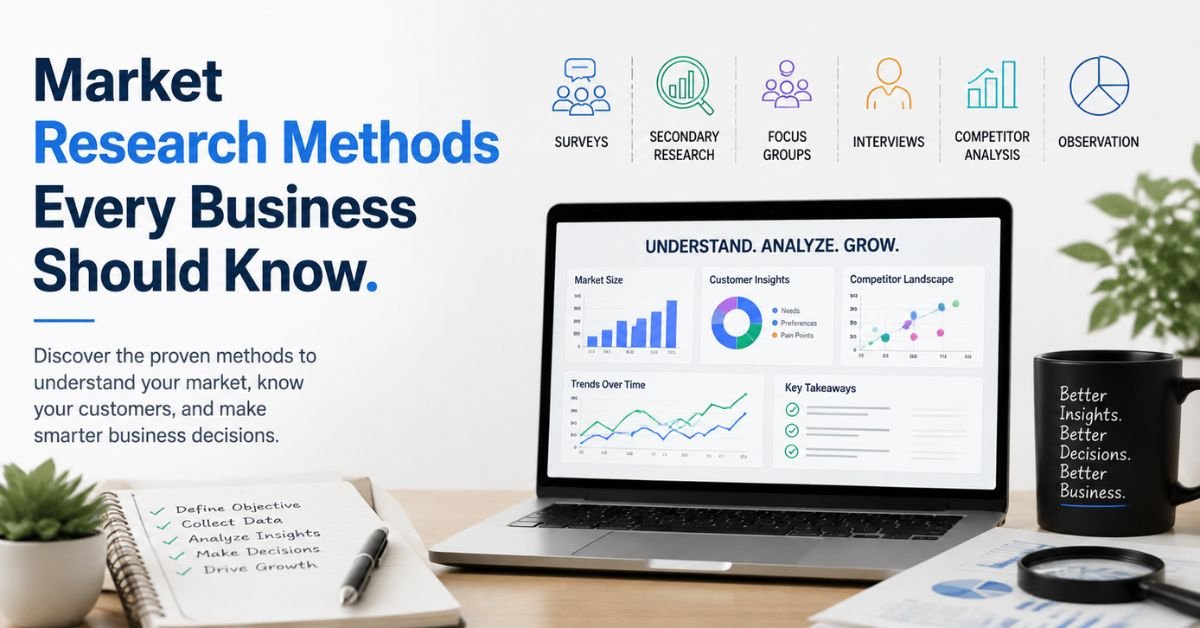
Surveys, interviews, focus groups, observation and user testing are among the common primary research methods. The right choice depends on whether the company needs breadth, depth, behavioral evidence, or some combination of them.
Surveys Help Measure Patterns Across a Larger Audience
Surveys work well when the business already knows which questions it needs answered and wants comparable responses from many people. They can measure awareness, buying habits, satisfaction, preferences, price expectations, purchase intentions, or reasons for choosing one provider over another. Consumer surveys are commonly used to collect structured feedback about preferences, behaviors, and purchasing motivations.
Suppose a UAE restaurant group is considering a new subscription-style lunch package. A survey could determine how frequently potential customers order lunch, which locations matter most, preferred price ranges, dietary requirements, and whether customers value delivery, collection, or dine-in access.
The key is to avoid asking customers to predict things they cannot reliably know. “Would you definitely buy this?” can produce optimistic responses. Questions about current behavior—such as what respondents purchased recently, how much they normally spend, and why they chose a particular option often produce more actionable evidence.
UAE surveys should also be designed around the intended audience rather than automatically treating respondents as one homogeneous group. Relevant segmentation might include emirate, customer type, residency profile, occupation, industry, purchasing role, language, or another factor directly connected to the decision being studied.
Interviews and Focus Groups Explain the Reasons Behind Decisions
Numbers can reveal what is happening. Interviews are better at uncovering why.
One-to-one interviews are especially useful in B2B markets, complex purchases, professional services, healthcare, industrial sectors, real estate and other situations where decision-making involves several considerations. Instead of forcing a customer into predefined answer choices, the interviewer can explore pain points, objections, buying criteria, supplier experiences, and unmet needs.
Focus groups bring several carefully selected participants into a moderated discussion. They can be useful when testing new propositions, brand messages, packaging, advertising ideas or perceptions of an unfamiliar concept. Participant interaction can expose opinions that may not emerge in an individual questionnaire, although strong moderation is needed to prevent a few voices from dominating the discussion.
In the UAE, this distinction matters. A property developer, for example, may discover through a survey that customers rank location highly. Interviews can go deeper: does “location” mean proximity to employment districts, schools, public transport, established communities, investment demand or future infrastructure? Those explanations change the business decision far more than the ranking alone.
Behavioral Methods Show What Customers Actually Do
What people say and what they do are not always identical. That is why strong market research includes behavioral evidence whenever possible.
Observation and Mystery Shopping Expose the Real Customer Experience
Observation focuses on actual behavior instead of reported behavior. A retailer can watch how customers move through a store. A restaurant can examine ordering patterns and waiting points. A property company can study where potential buyers hesitate during the inquiry process.
Mystery shopping applies a more structured version of this idea. A researcher behaves like a genuine customer and evaluates defined parts of the experience, such as response time, sales approach, product knowledge, service standards, follow-up, or competitor pricing.
Consider a Dubai clinic comparing its patient inquiry process with competitors. Calling competing clinics as a prospective customer could reveal whether appointments are easy to arrange, how services are explained, what information is requested, how quickly staff follow up, and whether pricing is communicated clearly. These observations reveal competitive strengths and weaknesses that may never appear on a competitor’s website.
Digital Behavior Adds an Always-On Source of Market Insight
A company’s existing digital channels can also function as research tools.
Website analytics can reveal where visitors come from, which content attracts attention, where users abandon a journey, and which acquisition channels lead to meaningful actions. Search behavior can help identify emerging questions and categories of demand. Reviews, customer-service records, CRM data, online inquiries and social conversations can reveal recurring frustrations or unmet expectations.
Google describes the modern customer journey as one that moves across searching, streaming, scrolling, and shopping rather than following a single linear path. For businesses, that makes digital behavior useful alongside not instead of direct customer research.
A useful principle is to compare stated preference with observed behavior. If customers say price is their main concern but consistently convert on premium packages with faster delivery, the behavior deserves attention. Interviews can then explore why.
Competitive Analysis and Concept Testing Turn Insight Into Decisions
Market research should not stop with the customer. Businesses also need to understand what customers are comparing them against.
Competitive analysis examines direct competitors, indirect alternatives, positioning, pricing, distribution, products, service models, marketing messages, customer reviews, target segments, and apparent strengths or weaknesses. The U.S. Small Business Administration treats market research and competitive analysis as complementary activities: one helps identify customers, while the other helps a company understand how it can differentiate itself.
The most useful competitor analysis goes beyond creating a list of companies. It asks questions such as: Where is the market crowded? Which needs are poorly served? Which competitors own particular positions? Where could a new offer be meaningfully different?
Concept testing then moves from market understanding to decision validation. Instead of fully launching an idea, a company can present alternative product concepts, service packages, prices, messages, prototypes or brand directions to target customers.
For example, an education company planning a professional training program in Abu Dhabi might compare three propositions: a low-cost online course, a premium classroom program, and a hybrid option with employer certification support. Testing those options before investing heavily in instructors, facilities, and advertising can reveal which proposition has the clearest appeal and what objections need to be solved.
The goal is not to ask customers to design the business for you. It is to expose assumptions to evidence before those assumptions become expensive commitments.
Choosing the Right Market Research Method
There is no single “best” method. Strong market research starts with the decision that needs to be made and works backward to the evidence required. WBS Advisory’s own process emphasizes defining research objectives, designing the research, collecting and analyzing information, conducting competitive analysis, profiling customers, and translating the findings into strategy.
A practical combination might look like this:
- Entering a new UAE market: Start with government and industry data, map competitors, conduct expert or buyer interviews, and then validate the opportunity with a targeted survey.
- Launching a product: Interview customers to understand needs, test concepts, run a survey to compare preferences, and validate the winning option through a small market test.
- Improving customer experience: Analyze CRM and digital behavior, review complaints and customer feedback, conduct observation or mystery shopping, and interview customers at key friction points.
- Repositioning a brand: Audit competitors, analyze customer perceptions, hold interviews or focus groups, and quantitatively test alternative positioning and messages.
Businesses should also plan data collection responsibly. The UAE’s Personal Data Protection framework regulates the processing of personal data and sets requirements around matters such as lawful processing, consent where applicable, transparency, data security, and individuals’ rights. Companies collecting identifiable respondent information should therefore build privacy considerations into questionnaires, recruitment, storage, and analysis rather than treating them as an afterthought. Specific requirements can also differ in jurisdictions such as the DIFC.
Most importantly, avoid choosing a method because it is fashionable or convenient. A large survey cannot repair a poorly defined business question. Ten excellent interviews may provide more value than thousands of superficial responses when the objective is to understand an unfamiliar B2B buying process.
Better Market Research Leads to Better Business Decisions
Market research is most valuable when it changes what a company does.
Secondary research establishes the market context. Surveys measure patterns. Interviews and focus groups uncover motivations. Observation and digital analytics reveal actual behavior. Competitive analysis shows where the business stands relative to alternatives. Concept testing helps determine whether an idea deserves further investment.
Used together, these methods reduce one of the greatest risks in business: making major decisions from internal assumptions alone. That is especially relevant in the UAE, where businesses can operate across different emirates, customer profiles, industries, and routes to market within a highly diversified commercial environment. Dubai’s economy alone spans substantial retail, real estate, transport, financial services, manufacturing, tourism and other sectors, reinforcing the need for research designed around a particular market rather than generalized assumptions.
For businesses that need a more structured approach, WBS Advisory’s market research services in Dubai and the UAE cover areas including market requirements, customer profiling, competitive analysis, segmentation, forecasting, feasibility assessment, and strategy development. Its published portfolio includes UAE market-analysis assignments as well as work related to industrial suppliers and hydro-farming projects.
The future of market research will bring faster analytics and increasingly AI-assisted analysis NIQ, for example, is already applying AI to qualitative insight generation but faster processing does not remove the need for good questions, representative inputs and sound business judgment. The businesses that benefit most will not necessarily be those collecting the most data. They will be the ones that know which uncertainty needs to be resolved before the next important decision is made.
Frequently Asked Questions
What are the main types of market research?
The two broad categories are primary research, which collects new information directly from the market, and secondary research, which analyzes information that already exists. Primary methods include surveys, interviews, focus groups, observation, and user testing.
Which market research method is best for a small business?
Start with low-cost secondary research and existing customer data. Then use targeted interviews or a concise survey to answer the most important remaining questions. The right method depends on the decision, not the size of the company.
When should a business use surveys instead of interviews?
Use surveys when you need comparable answers from a larger audience. Use interviews when you need deeper explanations of motivations, objections, purchasing processes, or unmet needs. Combining both can provide breadth and depth.
Where can UAE businesses find reliable secondary market data?
Useful official sources include UAE.Stat UAE government open-data resources, Dubai’s open-data portals, and Statistics Centre Abu Dhabi. The appropriate source depends on the emirate, sector and information required.
How often should a company conduct market research?
Major research is useful before decisions such as market entry, product launches, pricing changes or expansion. Customer feedback, competitor monitoring, digital behavior, and market signals should be reviewed continuously so decisions are not based on outdated assumptions. Market research is most effective when it becomes part of decision-making rather than a one-time exercise.